

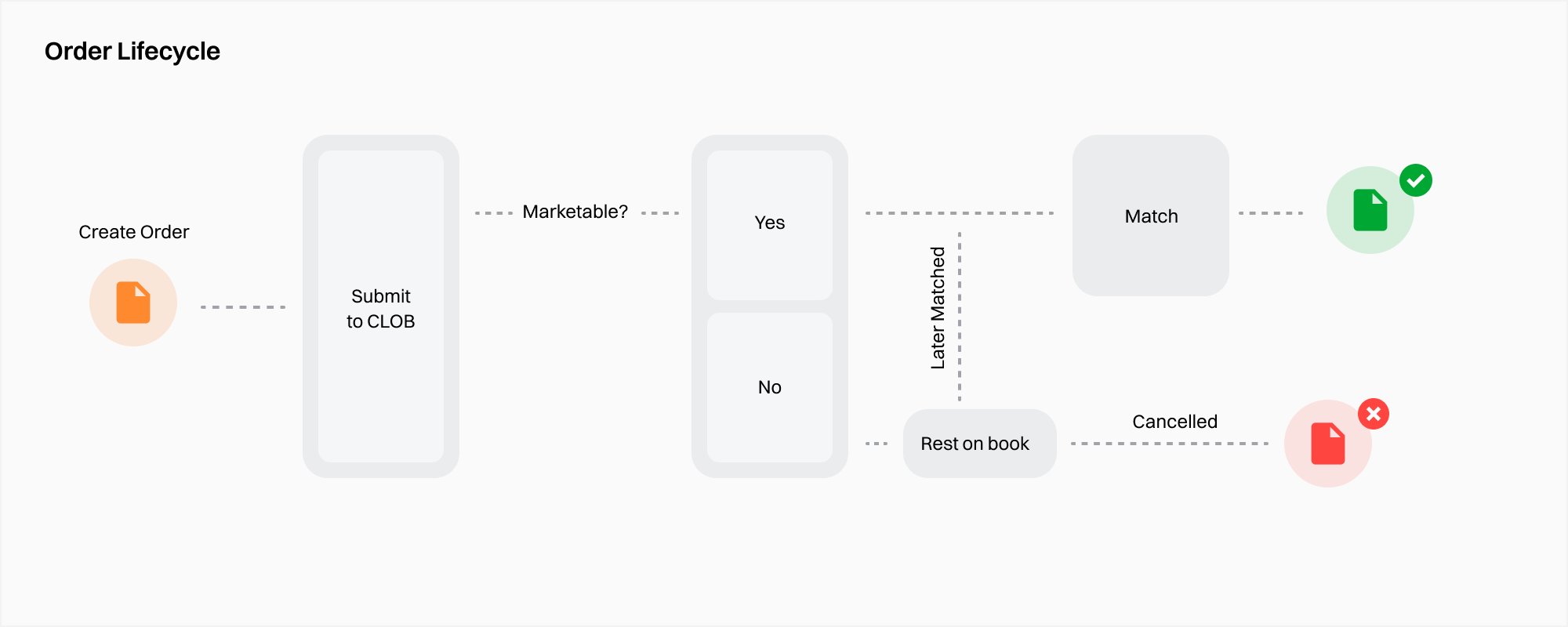
How Orders Work
At the protocol level, all CLOB orders can be treated as limit orders. What is commonly called a “market order” is effectively a sufficiently aggressive limit order that immediately crosses the order book. Matching follows price priority, then time priority: better prices execute first, and at the same price, earlier orders execute first.Time-in-Force Options
Use these values inorder_type. Set order_mode to LIMIT or MARKET.
Post Only
A Post Only order is guaranteed to act only as a Maker. If it would immediately execute against an existing order when submitted, it is rejected rather than consuming liquidity.Full Lifecycle
1
Create and Sign
Construct the order parameters, including Token ID, side (
BUY / SELL), price, quantity, expiration time, and timestamp, then sign the order with the trading wallet.2
Submit to the CLOB
The CLOB verifies the signature, balance, and allowance, and validates trading rules such as tick size and minimum order size. Invalid orders do not enter the order book.
3
Match or Rest on the Order Book
Orders that can execute immediately are matched against existing liquidity. Orders that cannot execute immediately remain on the order book until filled, cancelled, or expired. Some markets may apply a Taker matching delay to protect Makers.
4
Settle On-Chain
After matching, the settlement contract validates the orders and atomically transfers outcome tokens and USDT.
5
Confirm Completion
After the on-chain transaction is confirmed, account balances, trade records, and positions are updated.
REST Order States
REST order queries and thestatus filter use the following lowercase values. WebSocket order updates use a separate uppercase UI state.
Trade States
Maker and Taker
A Taker’s actual execution price is the resting counterparty price on the order book. For example, if a buy order has a limit of
$0.55 and matches a sell order at $0.52, the execution price is $0.52.
Cancelling Orders
Unfilled orders can usually be cancelled. Any portion that has already matched cannot be reversed; even if the remaining quantity is cancelled, the matched portion continues through settlement.Order Requirements
The maximum size available for a new order must subtract the balance already reserved by existing open orders:
Next Steps
Market Resolution
Learn how markets determine outcomes and how winning Tokens are redeemed.
Place Orders
View the trading API and order-placement flow.